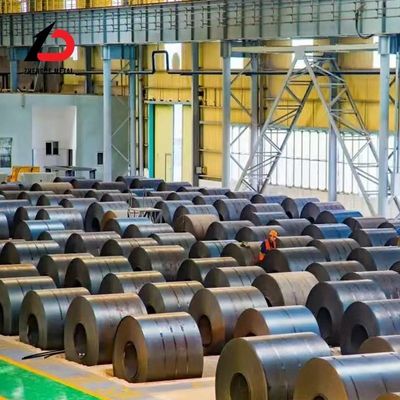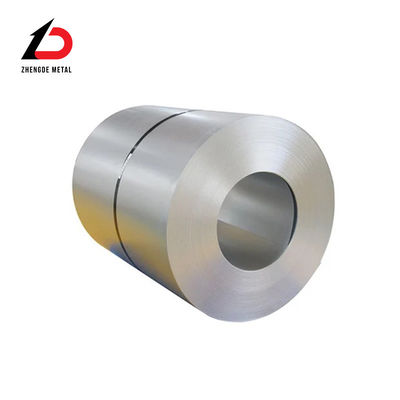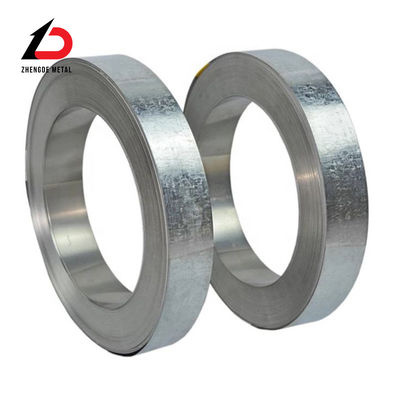


S420MC S420MC sits in the thermomechanically rolled family of EN 10149-2 steels, where strength comes from the rolling schedule instead of from alloying or quenching. That distinction matters in cold forming: the coil bends, flanges and stretches without the springback spikes and edge cracking that quench and tempered material produces on a press brake. Truck builders use it for longitudinal frame members, cross members and reinforcement plates where every kilogram removed from the chassis becomes payload.
Production starts with desulphurised continuously cast slab, heated in a walking beam furnace to a uniform temperature and rolled through roughing and finishing stands with interstand cooling. Thermo-mechanical control on the finishing train sets the grain size that later provides both strength and toughness. After coiling, each lot is sampled and tested for chemistry, tensile properties and, where the grade requires it, charpy impact energy. Results are attached to the coil number so that any downstream claim can be traced back to a single heat and a single rolling shift.
Key Features| Parameter | Specification |
|---|---|
| Steel Grade | S420MC |
| Standard | EN 10149-2 |
| Thickness | 2.0-8.0 mm |
| Width | 800-1650 mm |
| Coil Weight | 5-22 t per coil |
| Surface Condition | Pickled and oiled, mill finish on request |
| Thickness Tolerance | Thickness ±0.15 mm |
| Yield Strength | 420 MPa min |
| Tensile Strength | 480-620 MPa |
| Elongation | 16% min |
| Delivery Condition | As rolled, pickled and oiled, annealed or normalized on request |
| Inspection | Mill test certificate, third party inspection available |
Typical users are commercial vehicle frame plants, trailer and tipper body manufacturers, agricultural implement makers and crane outrigger fabricators. The coil also runs well through roll forming lines producing chassis rails, bumper beams and seat mounting brackets. Where a customer needs a lower yield point for a severe draw, we can quote the comparable S355MC or HC260LA grade from the same mill; where higher strength is needed for a weight critical design, S460MC and S700MC are available from the same production route.
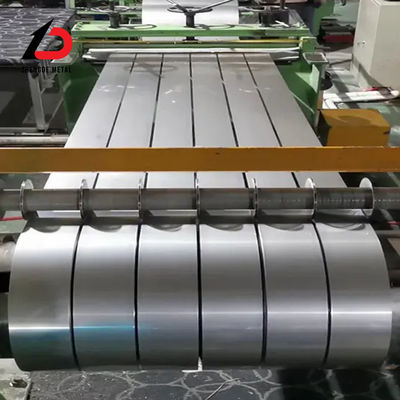
Because the coil is supplied rather than cut plate, buyers can nest parts across the full strip width, order only the tonnage a job requires and run the material straight onto an automated cutting or roll forming line. We quote slit to width as a standard option, and we confirm inner diameter, coil weight and winding direction against the customer's uncoiler before the order is rolled, so there is no adapter, no re-coiling and no scrap at the start of the run. Trial quantities of one coil are accepted for first orders, which lets a new customer verify formability and weld behaviour on their own equipment before committing to a full container.
Packaging and Quality AssuranceExport packing is agreed before production: standard sea worthy wrap, or reinforced packing with VCI film for long voyages to humid destinations. Steel strapping is applied with a tension that holds the wrap without crushing the coil edge, and every coil gets a lift point marked on the wrapper. Marking is stencilled in the language the buyer requests, and we photograph the loading pattern for each container so the customer can see exactly how the consignment was secured before the vessel sailed.
Every shipment is accompanied by a mill test certificate showing heat number, chemical composition, tensile results and, where the grade requires it, charpy impact energy. Third party inspection by SGS, BV, TUV or Intertek can be arranged at the mill before shipment, and we keep retained samples for twelve months so any question about a delivered coil can be answered against the actual test piece. Our quality system is certified to ISO 9001, and our documentation has been accepted by buyers in more than fifty countries. If a coil fails to meet the specification on arrival, we replace it or credit it, and we investigate the cause with the mill rather than leaving the customer to argue with a certificate.